
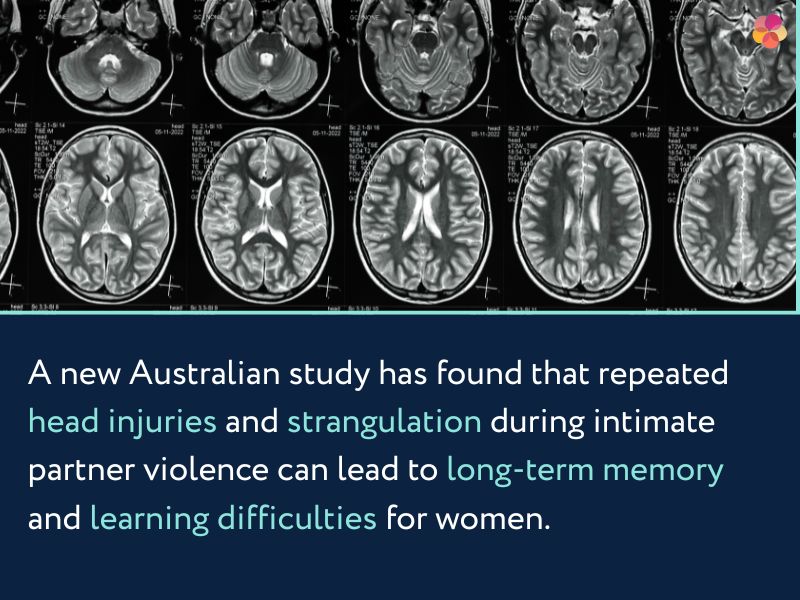


A new Australian study has found that repeated head injuries and strangulation during intimate partner violence can lead to long-term memory and learning difficulties for women.
The peer-reviewed research, led by Monash University and published in the Journal of Neurotrauma, compared the thinking and memory skills of women with no history of partner violence to survivors who had experienced abuse in the past.
The study focused on women living in the community, many of whom had never received a formal diagnosis of concussion or brain injury.
Researchers found that women who had experienced more than six suspected brain injuries — including concussions from head impacts and brain injuries caused by strangulation — performed significantly worse on tests of learning and memory. These differences remained even when factors such as age, mental health conditions, substance use and prior ability were taken into account.
The findings come amid growing public awareness of sports-related concussion, but experts say a much larger and less visible group remains overlooked: women injured through domestic, family and sexual violence.
ABC News reported on the experience of LJ, a survivor who took part in the study and said she had long dismissed her memory problems as “just how I am”. It was only through participating in the research that she began to connect those difficulties with repeated head injuries sustained during an abusive relationship.
Lead author and clinical neuropsychologist Dr Jennifer Makovec Knight said strangulation can cause brain injury by cutting off oxygen and blood flow to the brain — even when there are no visible injuries. Survivors are rarely screened for these injuries, and symptoms are often wrongly attributed to psychological trauma alone.
Illawarra Women’s Trauma Recovery Centre CEO Elise Phillips said the study provides long-needed evidence for a form of harm that has historically been overlooked in responses to domestic, family and sexual violence.
“This research provides critical insight into the long-term impacts of intimate partner violence that have often gone unrecognised,” Ms Phillips said.
“By identifying a link between repeated head injury and ongoing cognitive difficulties, the study strengthens understanding of how violence can affect women well beyond the immediate period of abuse.”
The authors said the findings highlight the need for greater attention to appropriate treatment, support and rehabilitation options.
“This study has highlighted the need for targeted assessment and intervention that addresses cognitive changes as well as comorbidities, including PTSD, substance use, safety, and other psychosocial challenges faced by women who are victims and survivors of IPV,” the study’s conclusion said.
The Illawarra Women’s Trauma Recovery Centre is a place for women to heal and rebuild their lives if they have or are experiencing domestic, family and sexual violence.
Our range of services supports women in living secure and independent lives.