
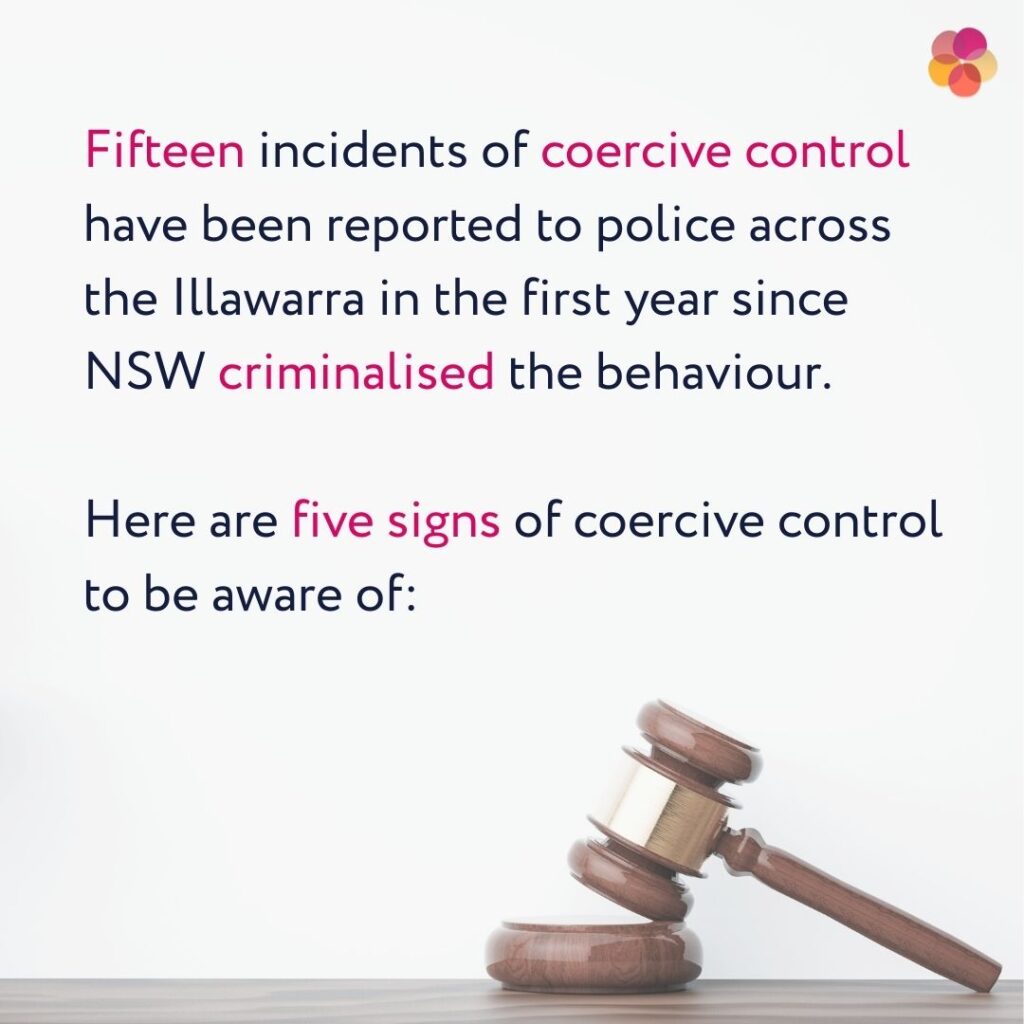


Fifteen incidents of coercive control have been reported to police across the Illawarra in the first year since NSW criminalised the behaviour, with new figures exposing both increasing recognition of the abuse and the challenge of turning reports into charges.
The latest monitoring report from the NSW Bureau of Crime Statistics and Research shows 386 coercive control incidents were recorded across NSW between July 2024 and September 2025, marking the first full year of data since the offence came into effect.
Coercive control refers to behaviours that strip away a person’s freedom and autonomy, including isolation from friends and family, surveillance, financial control and intimidation, often without leaving physical injuries. Instead, the harm builds gradually, leaving victims in fear and dependency.
Illawarra Women’s Trauma Recovery Centre CEO Elise Phillips said the figures reflect a growing understanding that domestic violence does not always look the way people expect.
“Domestic violence doesn’t always look the way people expect. It isn’t always physical violence or visible injuries – often it’s control, isolation, intimidation or financial pressure that slowly takes away a woman’s independence and confidence,” she said.
The offence was introduced in July 2024 and hailed as a turning point in recognising non-physical domestic abuse.
The NSW Government committed $5.6 million for police training and awareness campaigns to support the rollout.
Multiple tactics are used in most cases
The report shows coercive control rarely involves just one behaviour, with incidents involving an average of four different controlling tactics.
The most common behaviours recorded by police were harassment or monitoring, threats or intimidation, financial abuse, and social isolation. In some cases, physical violence was also present, but often alongside ongoing psychological and emotional control.
Women remain overwhelmingly affected, with 94 per cent of victims female, and most cases involving current or former intimate partners.
Few cases have reached court so far
Despite hundreds of incidents being recorded across NSW, only 18 coercive control charges have been laid so far, with most matters still before the courts.
The report shows the median delay between police recording an incident and charges being laid is nearly five months.
In many events (40 per cent), police instead laid charges for related offences such as assault, intimidation or property damage without using the specific coercive control charge.
Why awareness remains critical
Support services say the figures show awareness is improving, but coercive control remains difficult to identify and prove because it often involves patterns of behaviour rather than visible injuries or single incidents.
Under NSW law, coercive control is treated as a pattern of behaviour rather than a single incident, which means prosecutors must meet several legal tests before charges can succeed.
To secure a prosecution, several elements must be proved, including:
- a “course of conduct” (repeated or continuous abusive behaviour) against a victim
- that the perpetrator was at least 18 years old at the time
- that the perpetrator and victim were or had been intimate partners
- that the perpetrator’s actions were intended to coerce or control the victim
- and that a reasonable person would consider the conduct likely to cause either:
- fear of violence, or
- a serious adverse impact on the victim’s daily activities.
Five signs of coercive control to be aware of:
- Isolation from friends and family — A partner may discourage or prevent contact with loved ones, making it harder for someone to seek support or maintain independence.
- Monitoring or surveillance — This can include checking phones or social media, tracking movements, demanding constant updates on whereabouts, or becoming angry if someone is unavailable.
- Financial control — One partner may control money, restrict access to bank accounts, prevent the other from working, or closely monitor spending.
- Intimidation or threats — This may involve threats of harm, damaging property, threats relating to children or pets, or behaviour designed to cause fear even without physical violence.
- Loss of independence or confidence — Over time, someone may feel they need permission to make everyday decisions, feel fearful about upsetting their partner, or lose confidence in their own judgement. A common sign is when someone feels like they have to ‘walk on eggshells’.
These are just some examples of coercive and controlling behaviours. Find out more information here.
The Illawarra Women’s Trauma Recovery Centre is a one-stop place for women to heal and rebuild their lives after experiencing domestic, family and sexual violence. To find out more about our services, contact our team on 4243 9800.