


For many women, the hardest part of seeking support isn’t deciding to reach out but feeling unsure about what will happen next. Questions about what will be asked, who will be involved, and how the information will be used can cause worry and confusion.
This article aims to clarify what to expect when you first contact the Illawarra Women’s Trauma Recovery Centre. It explains how the initial (intake) conversation works and what happens afterwards, so women can approach the Centre feeling informed and supported.
Clare Craven, the Centre’s Intake Coordinator, emphasises that the first conversation is focused on understanding the woman as a whole person, rather than just discussing the details of her trauma.
“Recovery is not about rushing or fixing,” Clare stated. “It’s about creating safety, building trust, and collaborating with women to support them in a way that feels right for their individual journey.”
Making first contact
Women can contact the Centre by phone, email or in person or may be referred by a GP or community organisation.
The first point of contact is the Centre’s receptionist, who will collect some basic information and check eligibility.
The service is available to women who are over 18, identify as women, live in the Illawarra region (from Helensburgh to Gerroa), and have experienced domestic, family and/or sexual violence.
Eligible women will be placed on a waiting list for an initial intake appointment, with a current wait of 6 weeks.
Clare emphasised that staff are aware of how challenging waiting can be and strive to ensure that women feel supported during this time. “We don’t want anyone to feel forgotten,” she said. “We check in and discuss other potential supports that might help while women are waiting.”
It’s important to note that the Centre is not a crisis service. Women in immediate danger or in need of urgent assistance are encouraged to contact 1800 RESPECT (1800 737 732) or call emergency services at 000.
The First Conversation
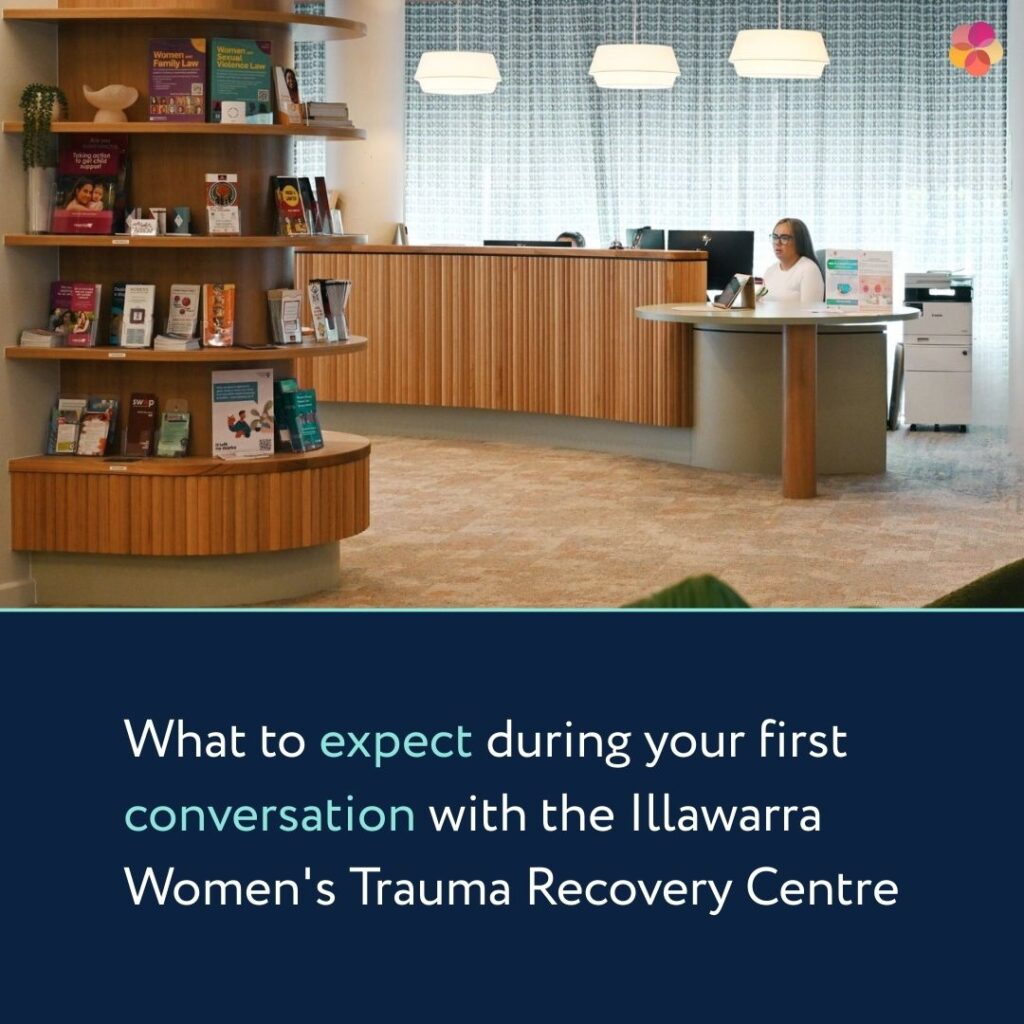
When an appointment becomes available, Clare will either call by phone or meet in person at the Centre, depending on what feels safest for the individual.
For face-to-face in-centre appointments, Women may also bring a female support person or support worker, who can wait in the lounge area or remain in the room, depending on the woman’s preference.
The conversation usually lasts up to 90 minutes. According to Clare, this duration reflects the Centre’s commitment to understanding women as whole people. “This isn’t about rushing through a checklist,” she said. “It’s about understanding what’s been happening in someone’s life and how it’s impacted them and their children”.
A Guided, Not Clinical, Process
The initial appointment is not an interrogation or a test; it is a holistic conversation at the woman’s pace. Women are not required to share details of their trauma. In fact, staff often advise against discussing specific traumatic experiences at this stage, as retelling such events can be distressing and is not necessary for planning effective care. Women can choose to provide a broad overview of their experiences or answer simple yes-or-no questions.
During the conversation, Clare may explain different forms of domestic and family violence, such as coercive control, financial abuse, or systems abuse. Many women are unsure if their experiences constitute abuse.
“For a lot of women, there’s a moment of real clarity,” she said. “Understanding that what happened to them wasn’t their fault can be incredibly powerful.”
Fairness, Safety, and Confidentiality
Having mental health concerns or issues related to substance use does not automatically restrict access to support.
The Centre welcomes women from all walks of life and acknowledges that their experiences are shaped by trauma, health, culture, and community.
Each woman’s story is heard with respect and cultural sensitivity, focusing on the support that is the safest and most helpful.
Women may be dealing with legal or court-related matters, including Apprehended Violence Orders (AVOs). These situations are approached with care and understanding and do not prevent access to support. The primary focus remains on safety and well-being.
The purpose of the initial appointment is to assess what support is safest and most beneficial at that time. In some cases, trauma-focused therapy may need to be deferred, especially during periods of acute mental health distress. When this occurs, staff will discuss alternative support options and encourage women to return when their circumstances improve.
“If we cannot provide the appropriate support immediately, we will discuss other options, and women are always welcome to return at a later time,” Clare said.
Information shared with the Centre is kept confidential. When there are legal obligations related to safety, these issues are addressed transparently and discussed with the woman.
Clare emphasised the importance of cultural safety, particularly for Aboriginal and Torres Strait Islander women who may have had negative experiences with systems in the past.
“We believe that women are already taking many steps to keep themselves and their children safe,” she said. “Our role is to acknowledge that effort, not undermine it.”
What Happens Next
When necessary, she discusses the next steps with the Centre’s team to ensure that support is tailored to each woman’s unique needs, goals, and safety considerations.
Women are typically contacted within two weeks to arrange an appointment to discuss these next steps, which may include counselling, group programs, casework, or other services offered by the Centre.
Taking the First Step
Clare mentioned that many women tell her that initiating contact is the most challenging part. “You don’t need to have all the answers, nor do you need to know exactly what you want,” she said.
“Just reaching out is already a significant step.”
How the process works
First contact
- Contact us by phone, email or by walking in
- We’ll undertake a basic eligibility check
- If eligible, you’ll be added to the waiting list for a holistic intake and assessment
Getting-started appointment
- We’ll set up an intake appointment – this can be by phone or face-to-face
- The appointment can take up to 90 minutes
- The appointment is a guided conversation – not a test
- You decide what you share
- A female support person is welcome to attend with you
Discussion areas
- Current supports and well-being
- Safety for you and your children
- Health, well-being, and how you’re coping day to day
- Your strengths, resources and goals
- What support might help you next
After the intake and assessment
- Receive contact from TRC within two weeks
- Attend a connection meeting with a counsellor, case worker or group worker
- Develop a healing plan outlining your healing goals
- Agree on which services at the Centre are the best fit to help you achieve your healing goals
- Plan next steps together
If you have more questions, please contact us, or check our FAQs.