
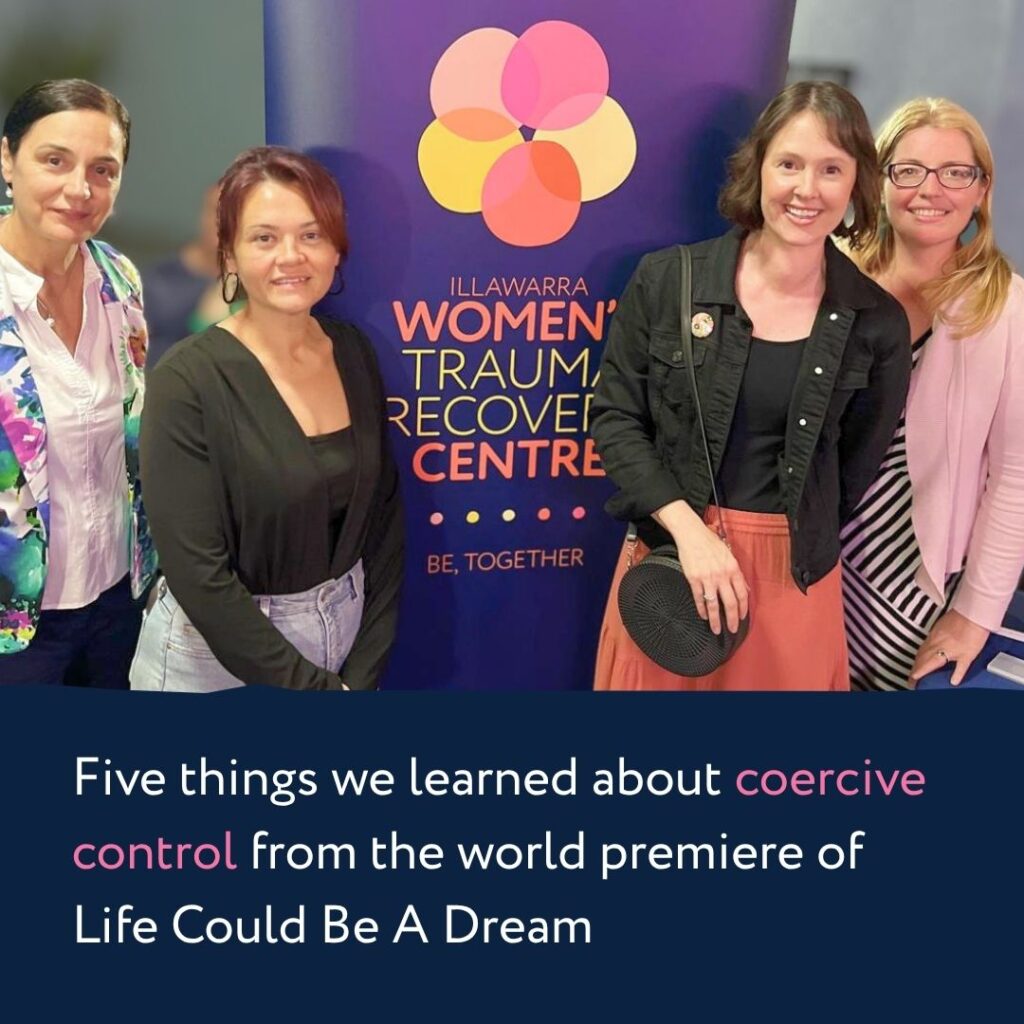


A packed house at Gala Cinema Warrawong marked the world premiere of Life Could Be a Dream, a new Australian film exploring coercive control.
The screening raised funds for the Illawarra Women’s Trauma Recovery Centre and took a first look at the film with a candid Q&A with the cast and creatives, offering insight into how coercive control is experienced, understood, and too often overlooked.
The film follows Sarah, a forty-year-old woman, and her teenage son, Otis, as they navigate their way toward freedom. At its heart, the film explores the fierce and fragile bond between mother and son as they attempt to break cycles and redefine love on their own terms.
Here are five things we learnt about domestic, family and sexual violence from the screening.
1. It doesn’t look the way people expect
Director Jasmin Tarasin said the team deliberately focused on “one woman’s story” that might feel “unexpected.” The film is set in an affluent community and challenges the idea that domestic abuse only happens in certain households.
Writer Courtney Collins pointed to a key line in the film, “What more could you want?, as capturing how appearances can obscure what’s really happening behind closed doors.
2. Control is often hidden, not obvious
Collins described coercive control as “the invisible architecture” shaping a person’s life.
The film shows how patterns of manipulation, isolation and fear can build over time, often unnoticed from the outside.
3. Everyone’s recovery story is different
Rather than ending with escape, the film focuses on what comes next. It follows Sarah and her teenage son as they rebuild their lives amid moments of fear and uncertainty. The story highlights how healing often means learning to live without control, and redefining safety, trust and love over time.
4. Telling hopeful stories matters
For Women’s TRC CEO ElisePhillips, the film’s ending was critical: “I like that it ended with hope. It’s only by sharing hopeful stories of healing and recovery that we can encourage people to realise that there is a life on the other side.”
“Every woman deserves the chance to recover, rebuild and live free from violence. Events like this not only raise vital funds for our services but also help spark important conversations about recovery, resilience and hope.”
5. Organisations were willing to fund an important cause
Tarasin revealed the project was backed outside traditional screen funding pathways, with funding coming from Minderoo, the Snow Foundation, and CBA – Next Chapter.
“This film was made… as a reaction to the state of play in our society and the epidemic of teenage violence,” she said.
“This film was made untraditionally with philanthropic and private investment… It was quite a rare beast in that way.”
Life Could Be a Dream is set for a national cinema release in May 2026.