
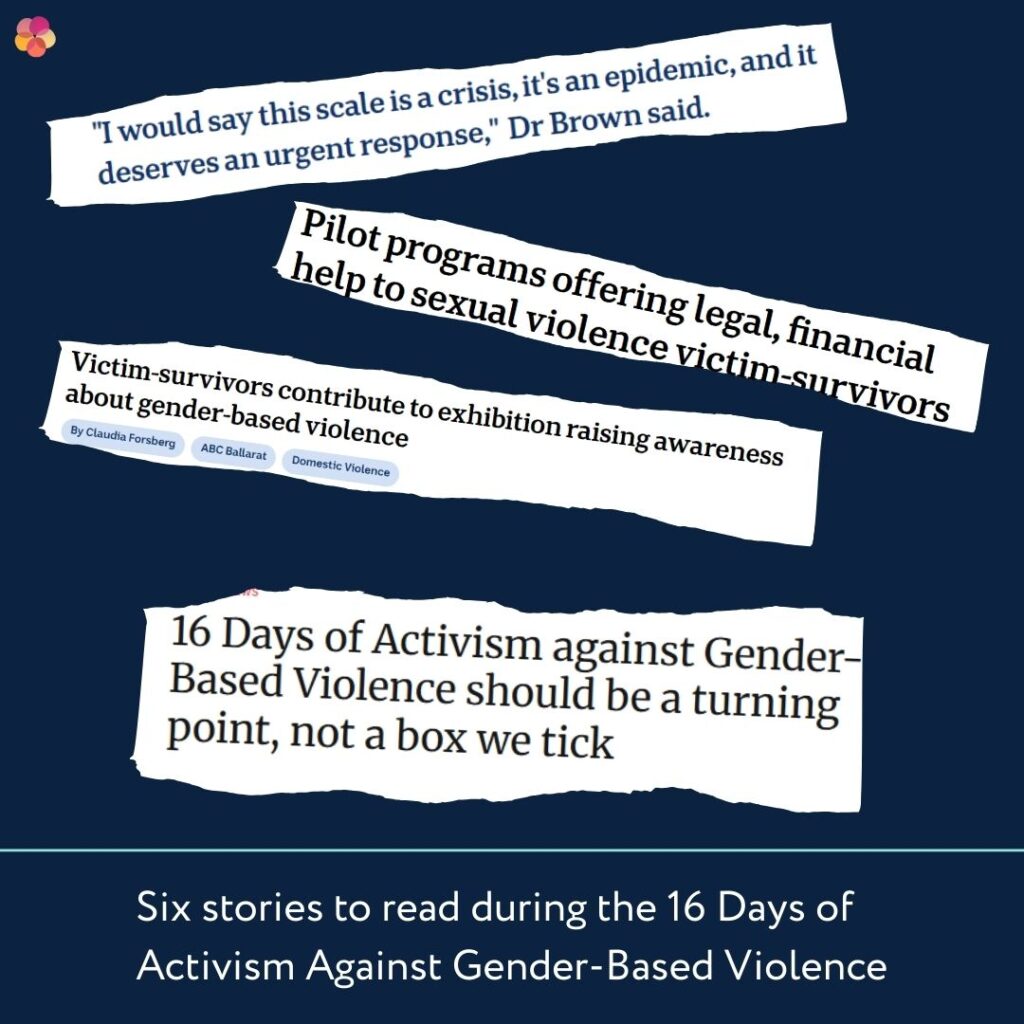


As the world marks the 16 Days of Activism Against Gender-Based Violence, the past week’s reporting in the media has delivered a confronting snapshot of the scale of Australia’s crisis, and the growing public demand for change.
As Rita Nasr writes in Women’s Agenda, the 16 Days should not be reduced to a tick-box exercise; it is a global call to confront systems that excuse, minimise, or enable violence, and to commit to the cultural, legal and institutional change needed to end it. What we’ve been reading this week reflects exactly why these 16 days must spark something lasting.
In the Northern Territory, frontline workers say the domestic, family and sexual violence crisis continues to escalate. The ABC News reported that shelters are turning away record numbers of women and children, a year after a landmark inquest into the domestic violence deaths of four Aboriginal Women handed down 35 recommendations to improve safety responses.
Ms Aitcheson said Dawn House was so overwhelmed with victim-survivors escaping violence, it was turning away 200 women per month, and the service had only been able to accept those at “immediate risk of death”.
“We’re 12 months down the track, and we’re just not seeing a difference in service delivery,” Ms Aitcheson said.
A new study reported by The Conversation revealed that half of the women interviewed while leaving nightclubs recently experienced sexual comments, groping, or forced kissing.
The unsolicited acts were most likely on the dance floor, and the darker the venue, the greater the risk. The responsibility to stay safe, including actions like covering drinks, not going anywhere alone, and pretending to have a boyfriend, continues to fall on women.
The researchers argue that nightlife venues could be designed and managed to reduce harm rather than relying on patrons to protect themselves.
“Patrons are expected to prevent harm by covering their drinks, not going anywhere alone, or pretending to have a boyfriend when approached. These strategies are often described by patrons as “necessary” for staying safe when there are few other protections in place, the article said.
“However, the design, atmosphere and management of nightlife venues can increase or decrease the risk of sexual harm, as our research shows.”
Specialised trauma-informed sexual violence legal services in the ACT and Western Australia are being expanded as part of an existing $19.6 million investment by the federal government.
The ABC story outlined how the pilot programs were immediately successful, with appointments filling up rapidly upon launch.
Women’s Legal Centre chief executive officer Elena Rosenman said 300 people had been assisted in Canberra since the pilot began in 2024.
“We knew the need was there [but] we had no idea how deep the unmet legal need in this space was,” she said.
As well as extending the existing pilots in the ACT and WA, the government announced the establishment of similar pilots in the Northern Territory, South Australia and Tasmania.
The government also said it would work to establish pilots in Queensland, Victoria and New South Wales.
The BBC aimed to cast some positivity by profiling a UK rugby team’s social media campaign, urging people to stand up when they witness domestic, family and sexual violence. “We want to show our support for women and girls and to end domestic violence, not just in Cornwall, but globally,” said Cornish Pirates coach Neil Smith.
Players hope the campaign will inspire more bystanders to intervene and challenge harmful attitudes.
And in Ballarat, a new exhibition, Transforming Pain into Power, opened at the local library, showcasing works by victim-survivors reflecting on their experiences. Co-organiser Ash Milne of WRISC said: “Artwork and creativity are a powerful form of recovery and healing. Having this public event is a way of taking that one step further and showing the collective power of the voice.”
The Illawarra Women’s Trauma Recovery Centre is a place for women to heal and rebuild their lives if they have or are experiencing domestic, family and sexual violence.
Our range of services supports women in living secure and independent lives.