

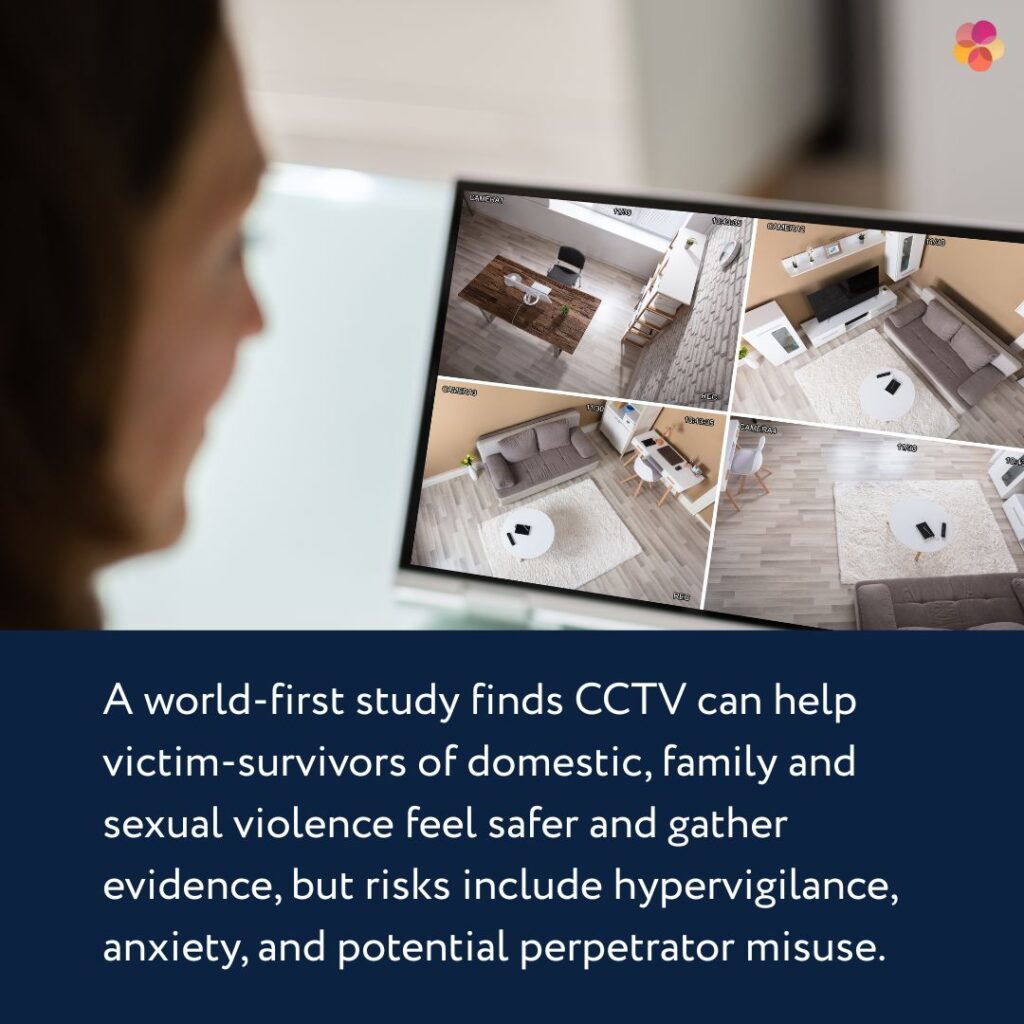


A new national study from the Australian Institute of Criminology has highlighted the complex impacts of closed-circuit television (CCTV) on women experiencing domestic, family and sexual violence.
The world-first research, entitled The impacts of CCTV on victim-survivors of domestic and family violence published by the Australian Institute of Criminology in September 2025, draws on a survey of 125 frontline practitioners as well as interviews with victim-survivors, security providers and support services.
It focuses on CCTV use in private settings, particularly in the homes of victim-survivors and within domestic violence refuges.
The research examines how women experiencing domestic and family violence interact with cameras when they are installed as part of safety planning.
It explores both the emotional impacts – such as feeling safer or, conversely, becoming more anxious and hypervigilant, and the practical issues around evidence collection, system reliability, and the potential for perpetrators to misuse or damage the technology.
It found that while CCTV can provide safety benefits and valuable evidence, it also carries risks that must be carefully managed.
Executive Director of the Illawarra Women’s Trauma Recovery Centre, Sally Stevenson, said the report underscored the need for tailored responses:
“This research shows the use of CCTV is not a simple solution. For some women, it can bring peace of mind and vital evidence. For others, it can heighten fear or even be turned against them,” she said.
“We must ensure these choices are backed up with other supports including trauma and violence-informed counselling, safe housing, legal protection and community services, so that no woman is left relying on cameras alone.”
The report found safety and reassurance were the most commonly cited benefits of installing CCTV.
Over 21% of practitioners said cameras gave their clients peace of mind, reducing anxiety at night or when alone at home. Some women reported that CCTV allowed them to remain in their homes rather than relocate, because the presence of cameras restored a sense of control.
The study also confirmed the value of CCTV footage to support police reports with 47% of practitioners saying this was a key benefit with the report saying victim-survivors had successfully used recordings of threatening behaviour to support police reports, AVO breaches and prosecutions.
But the report warns that these benefits can come at a cost, with some women becoming hypervigilant, checking footage constantly and experiencing heightened anxiety.
There is also the risk of aggravating perpetrators when the use of cameras is introduced.
While many of the 39% of practitioners considered escalation unlikely, the report cautions that such outcomes cannot be dismissed with 45% of practitioners stating they were ‘not sure’ if installing cameras would create an increased risk.
The report concludes that CCTV should never be seen as a standalone response but as one component of a broader safety plan and highlights the importance of training or guidance.
“Consideration should also be given to developing training or guidance alongside engagement with DFV healing and recovery programs that can support clients who may experience CCTV-related hypervigilance or anxiety in addition to other forms of abuse,” the report said.
Barriers to CCTV include cost, wifi access, electricity, and neighbours (assuming the cameras are outside) programs such as Staying Home Leaving Violence support women to access equipment to stay safe, but often have long waitlists or are closed for referrals.
In the Illawarra, this service is provided by Family Services Australia.
The Illawarra Women’s Trauma Recovery Centre is a place for women to heal and rebuild their lives if they have or are experiencing domestic, family and sexual violence.
Our range of services supports women in living secure and independent lives.